Smart Shower Testing
How to Test a Smart Shower: Commands, Protocols, Temperature, and Valve Traces
A practical guide to smart shower hardware testing across button events, UART frames, outlet switching, motor position, temperature traces, faults, and reports.
What does a smart shower test need to prove?
Smart shower testing should show that a user command becomes the correct hydraulic action, that the interface reports the real state, and that temperature and safety behavior remain controlled through the transition. “Water came out” is only the beginning.
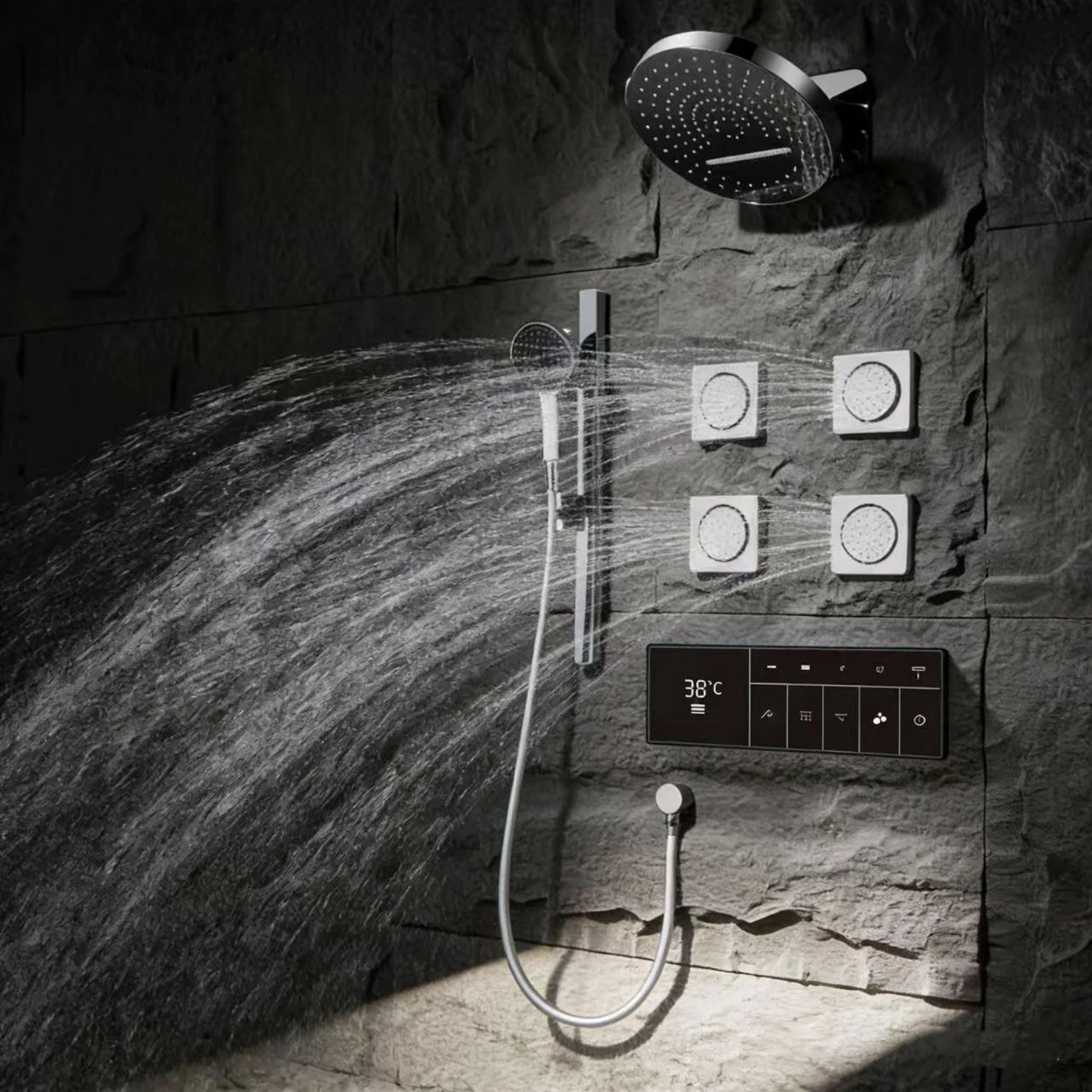
A smart shower may include a control panel, main controller, temperature sensor, hot- and cold-water actuators, an outlet selector, display or LEDs, and remote-control modules. A useful test connects these layers on one timeline so an engineer can tell where a delay, wrong outlet, unstable temperature, or fault began.
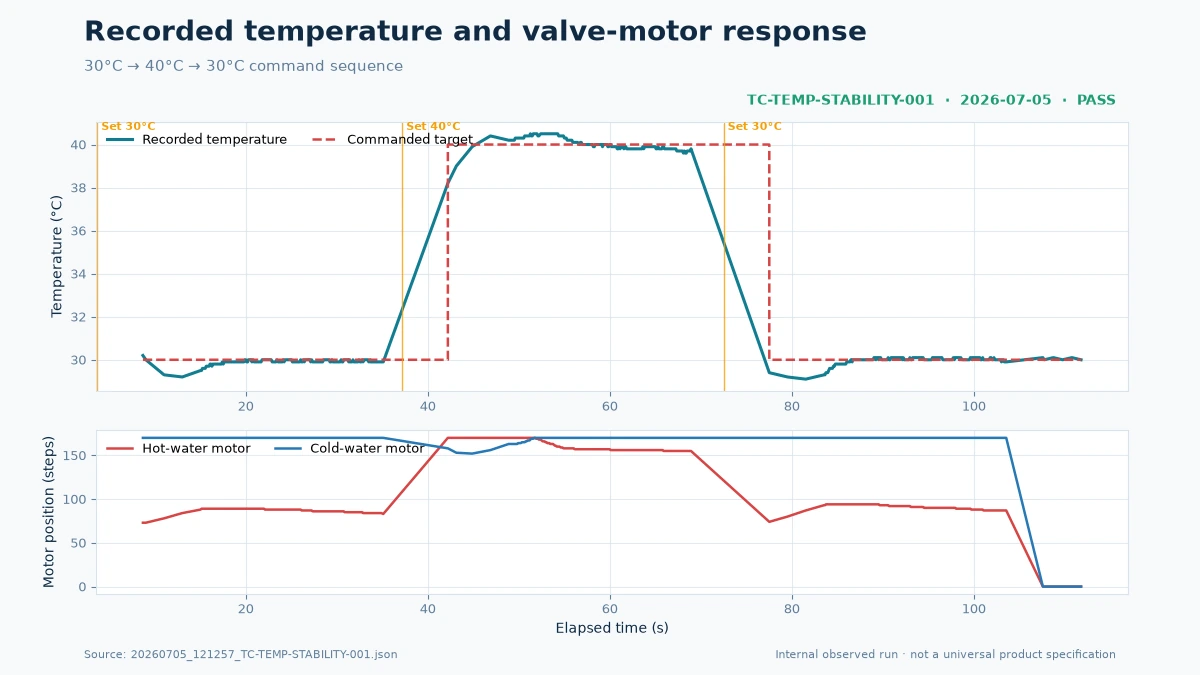
The cover chart is generated from the recorded PASS log TC-TEMP-STABILITY-001. It aligns the 30°C → 40°C → 30°C command sequence with measured temperature and hot- and cold-water motor positions; it is an internal observed run, not a universal product specification.
Start with user behavior, not a hidden script
A readable test begins with an action a person might perform: select the hand shower, increase temperature, change flow, switch to an overhead outlet, start warm-up mode, or stop the water. The automated case then describes setup, steps, waits, and expected behavior in data rather than burying the intention in custom code.
For example, a test definition may send an outlet command, wait for the controller to report the requested mode, collect status for a defined period, and then verify the final state. This definition is a test method and acceptance target. It is not evidence that a physical unit passed until a recorded run can be tied to the hardware, software, fixture, and conditions.
The end-to-end test chain
A complete run follows the product rather than one subsystem:
- A button, test rig, or remote interface issues a user-level command.
- The command is encoded into the product communication protocol.
- The main controller validates and interprets it.
- The product state machine selects the allowed transition.
- Hot, cold, and outlet actuators move as required.
- Temperature and state feedback are sampled.
- LEDs, display, and status frames report what the user should see.
- The logger preserves raw and structured evidence for review.
If the test checks only the final state, it may miss a delayed command, a misleading LED, an intermediate outlet, an actuator that stopped short, or a brief temperature excursion.
Protocol-level testing: verify what the controller received
In WUGONG's FaucetCore implementation, the control panel and main controller communicate over a 9600-baud UART. A button command frame contains a header, command identifier, and checksum; a status frame returns fields including the active indication, measured temperature, flow level, temperature setpoint, and event state.
That implementation is one concrete example, not an industry-wide protocol. The general protocol tests still apply:
- valid commands produce the documented response;
- an incorrect header, length, identifier, or checksum is rejected safely;
- malformed input does not move a valve or corrupt state;
- timeouts and partial frames recover predictably;
- rapid commands follow a defined last-command or queue policy;
- status data contains enough information for diagnosis.
Passing a UART test proves communication behavior for the tested version. It does not prove that the mechanical valve moved, the selected outlet carried water, or the temperature was comfortable. Those layers need their own observations.
Outlet-switching tests: inspect the transition
Multi-outlet systems may route water to a hand shower, overhead shower, side spray, tub filler, or another mode. The user experiences the transition, not only the final label. Test records should therefore align:
- the requested outlet and command time;
- state-machine transition and reported mode;
- outlet actuator target and observed position;
- visible LED or display state;
- water behavior where the fixture can measure or observe it;
- ignored commands, timeouts, and fault events.
WUGONG's current architecture uses a dedicated outlet stepper motor, separate from the hot- and cold-water actuators. That separation helps diagnosis: an outlet-selection problem can be studied without assuming the temperature actuators are responsible. A recorded pass under one flow condition, however, does not establish switching behavior at every pressure or with every valve body.
Temperature and actuator traces explain control behavior
The temperature trace answers whether water approached and remained near the setpoint. Hot- and cold-water actuator traces show how the system changed the mix. Together they can reveal slow response, overshoot, repeated correction, mechanical limits, delayed sensing, or supply disturbances.
Do not interpret one final temperature as a stable result. A proper analysis defines the start event, response-time rule, allowable band, stable-duration rule, observation window, and whether data after a stop command is excluded. The dedicated smart shower temperature-control testing guide explains these metrics.
Warm-up, safety, and fault-state tests
Some behaviors are state-machine problems rather than steady-state measurements. Warm-up or cold-water purge should verify the selected outlet, indication, temperature condition, pause or waiting state, user stop, and safe exit. It must also be distinguished from a hot-water recirculation system. See the smart shower warm-up guide.
Safety testing may cover over-temperature behavior, sensor faults, communication loss, actuator limits, abnormal supply, and recovery after a stop. The expected safe state has to be defined before the run. A log that contains no reported fault does not prove the fault protection works unless the fault was intentionally and safely introduced.
Preserve raw data and structured data
WUGONG's test framework can produce three useful layers:
- a binary stream for protocol-level reconstruction;
- structured JSON containing samples, events, summary fields, and verdict data;
- a readable Markdown summary for rapid review.
The structured log should remain the source for calculations and charts. An AI-assisted summary can highlight transitions or anomalies, but it may simplify the time window, repeat a configured target as if it were a result, or miss a post-stop sample. Any published number should be recalculated from the structured record and tied to its conditions.
What a useful smart shower test report contains
A good report is layered:
- Identity: product, controller and firmware version, fixture, date, and operator or run ID.
- Conditions: inlet temperatures and pressures where measured, flow setting, target temperature, outlet, supply voltage, sample rate, and duration.
- Method: test definition, setup, commands, waits, and acceptance criteria.
- Verdict: which assertions passed or failed and why.
- Timeline: command, reported state, actuator, temperature, LED, and fault events aligned by time.
- Charts or tables: readable views derived from structured data.
- Raw evidence: preserved files that allow later recalculation and protocol review.
The summary should compress evidence, not replace it. A dashboard screenshot without raw data, units, conditions, and a reproducible calculation is not enough for a performance claim.
How to read PASS and FAIL correctly
PASS means the recorded run satisfied the assertions implemented for that case. It does not mean the entire product is validated, ready for every market, or immune to other conditions. FAIL may point to the device, the fixture, the method, communication, an incorrect expectation, or the analysis code; the timeline is needed to locate the cause.
Before using a result publicly, check:
- whether the assertion actually evaluated the claimed behavior;
- whether physical water was present when the case required it;
- whether the hardware and software versions are identifiable;
- whether the conditions represent the intended installation range;
- whether repeated runs support the same conclusion;
- whether the calculation excludes setup, shutdown, or invalid samples.
Frequently asked questions
Can a simulation replace hardware testing?
No. Simulation and unit tests are useful for algorithms and software paths, but physical valves, sensors, water pressure, temperature, tolerances, and installation effects require representative hardware.
Why record motor or valve position?
It helps distinguish a command problem from an actuator or hydraulic problem. A reported mode can be correct while a mechanism is delayed, short of target, or mechanically blocked.
Does a PASS result mean the shower is ready for production?
No. It means that run met the assertions in that test. Production readiness requires coverage across functions, safety, environmental conditions, tolerances, reliability, manufacturing variation, and applicable compliance requirements.
Is a successful UART test enough?
No. It validates the tested communication behavior. Mechanical movement, outlet flow, temperature control, interface timing, and safety still need separate or end-to-end verification.
What data should be kept after a test?
Keep the test definition, configuration without secrets, product and software identity, structured samples, events, verdict details, charts, and raw protocol data where needed for later diagnosis.