Shower Warm-Up Mode
How Smart Shower Warm-Up Mode Works: Cold-Water Purge, Pause Logic, and Testing
Learn how smart shower warm-up mode purges cold water, detects temperature, pauses flow, differs from recirculation, and should be tested.
What is smart shower warm-up mode?
Smart shower warm-up mode is a controlled sequence that moves standing cold water out of the pipe before normal showering and then signals, pauses, or changes state when a temperature condition is reached. It is also described as cold-water purge or cold-start preparation.
The comfort benefit is straightforward: the user does not have to stand under the outlet while the pipe warms. The water and energy tradeoff is more complicated. If the cold water runs to the drain, the feature changes when the user encounters it but does not recover that water. A true recirculation system routes water back through a return path and is a different plumbing architecture.
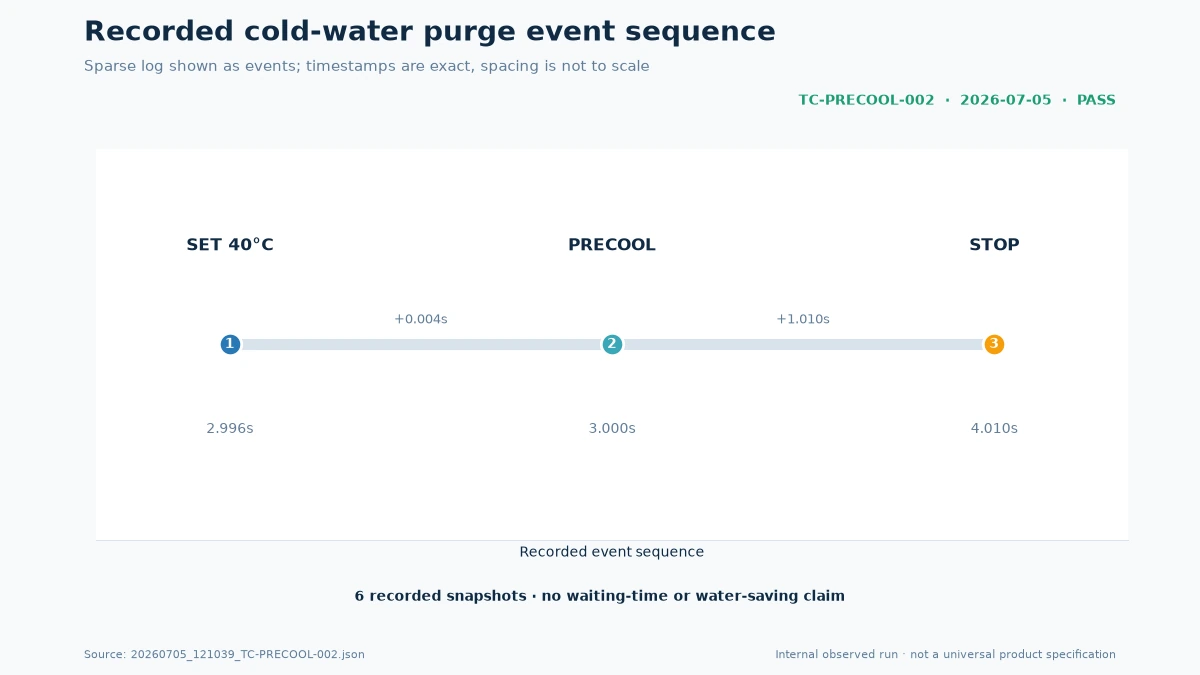
The cover is generated from the recorded PASS log TC-PRECOOL-002. Because that run contains only six snapshots, it shows the exact SET 40°C → PRECOOL → STOP event timestamps without presenting a continuous performance curve or claiming waiting-time or water savings.
Why cold water appears before hot water
After a shower has been off, water remains between the heater or hot-water source and the outlet. That standing water cools toward the surrounding temperature. When the next user opens the shower, it must leave the pipe before newly heated water arrives.
The delay depends on pipe length and diameter, water volume, heater location and startup behavior, flow rate, insulation, ambient conditions, and whether other fixtures recently used the hot line. A controller at the shower cannot remove this physical volume; it can only manage the process and feedback.
A typical purge state sequence
A robust warm-up function may follow this pattern:
- The user selects warm-up or cold-water purge.
- The controller verifies that starting the selected outlet is allowed.
- The product enters a visible purge state.
- Water flows through the intended outlet while temperature is monitored.
- When the defined temperature condition is satisfied, the product pauses, waits, signals readiness, or transitions according to its design.
- The user starts normal showering, or the system exits after a timeout.
- STOP and fault commands remain available throughout the sequence.
WUGONG's current FaucetCore implementation includes separate states for switching into cold-water purge, purging, waiting, running, closing flow, and closing the outlet. That implementation supports explaining the state machine; it does not prove a universal warm-up time.
Purge-to-drain and hot-water recirculation are different
| Feature | Purge to outlet or drain | Recirculation system |
|---|---|---|
| Water path | Standing water leaves through an outlet or drain | Water returns through a loop or crossover path |
| Extra plumbing | May use the normal shower water path | Often needs a return path, crossover valve, pump, or building provision |
| User contact with cold water | Can be reduced by timing and pause logic | Can be reduced by preheating the loop |
| Water recovery | Normally no | Potentially yes, depending on design |
| Energy use | Hot-water source and shower controls | Adds recirculation pump and possible heat loss from warm pipes |
Neither category is automatically more sustainable without measuring water, energy, standby behavior, pipe losses, and user habits. “Warm-up mode” should not be advertised as recirculation unless water actually follows a recirculation path.
Temperature logic and pause behavior
The controller needs a clear rule for deciding that warm water has arrived. Possible rules include crossing a threshold, entering a band near the user's setpoint, or remaining within a band for a defined period. Sensor location matters: a sensor inside the valve body may detect warm mixed water before it reaches the final outlet through a long downstream pipe.
Automatically continuing full flow after the threshold can surprise a user who is not yet in the shower. A waiting or pause state can separate “the line is warm” from “begin normal showering.” The interface should make that state obvious and explain how to resume.
STOP, timeout, and fault behavior
Warm-up must never become a mode that the user cannot interrupt. Test at least:
- STOP immediately after warm-up begins;
- STOP while the outlet or valve is moving;
- STOP while water is flowing;
- no temperature rise before timeout;
- implausible or missing temperature data;
- communication loss or a stalled actuator;
- a second outlet command during warm-up;
- restart after a normal stop and after a fault.
The safe outcome should be defined for each case: close flow, close or park the outlet, report a fault, and return to a known state.
Observed example: what one recorded run proves
An internal WUGONG log, TC-PRECOOL-002, tested the stop path during cold-water purge on July 5, 2026. In the event timeline, the rig set a 40°C target at 2.996 seconds, issued PRECOOL at 3.000 seconds, and issued STOP at 4.010 seconds. The case result was recorded as PASS.
This supports a narrow claim: in that hardware and software run, the configured test observed the stop sequence that its assertions expected. It does not prove how much cold water was displaced, how long a user would wait, whether the outlet had representative plumbing, or whether the feature saved water. Those outcomes were not measured in that log.
How to measure comfort and water use
To evaluate the experience, record:
- pipe volume and layout from the hot-water source to the shower;
- hot and cold inlet conditions and initial pipe temperature;
- selected outlet and flow rate;
- time from command to temperature at the control sensor;
- time from command to temperature at the user outlet;
- volume discharged before readiness;
- pause or notification time and user restart behavior;
- energy used by heaters, pumps, and standby functions where relevant.
Use a baseline without warm-up and repeat under comparable starting conditions. A shorter time at the control sensor does not necessarily mean less water at the drain, and moving cold water before the user enters does not automatically reduce total consumption.
Interface and indicator testing
The user needs to distinguish idle, purging, ready or waiting, normal running, and fault states. Test the LED, display, sound, or app feedback at the same time as the actual state. An indicator that changes before the valve or temperature condition is true creates false confidence; one that changes too late makes the feature feel unresponsive.
The complete smart shower testing guide explains how to align commands, status frames, actuator positions, temperature, and visible feedback on one timeline.
Frequently asked questions
Does cold-water purge waste water?
If water is discharged to the drain, it still uses that volume. The function may improve comfort or change user behavior, but savings require a measured comparison. Recirculation follows a different water path.
Does warm-up mode require a return pipe?
Purge-to-drain does not normally need a return pipe. True recirculation may require a dedicated return or an approved crossover arrangement, depending on the plumbing design.
Will the shower start automatically when it is warm?
That is product-specific. Some designs pause or signal readiness; others transition. The behavior should be explicit and tested so the user is not surprised.
Can the user stop warm-up at any time?
They should be able to, and STOP behavior should be verified during each transition state rather than only from steady operation.
Is warm-up mode the same as thermostatic control?
No. Warm-up manages the cold water already in the pipe and the transition into use. Thermostatic control regulates mixed-water temperature during operation.