Patent Deep Dive
How CN110629859B Works: The Self-Cleaning Floor Drain Mechanism
CN110629859B is Wugong's granted patent for an easy-clean floor drain: a lift-out cover whose skirt collects the hair, open comb grooves that filter without trapping it, and a connecting shaft that lets tap water spin the cover clean.
What CN110629859B is
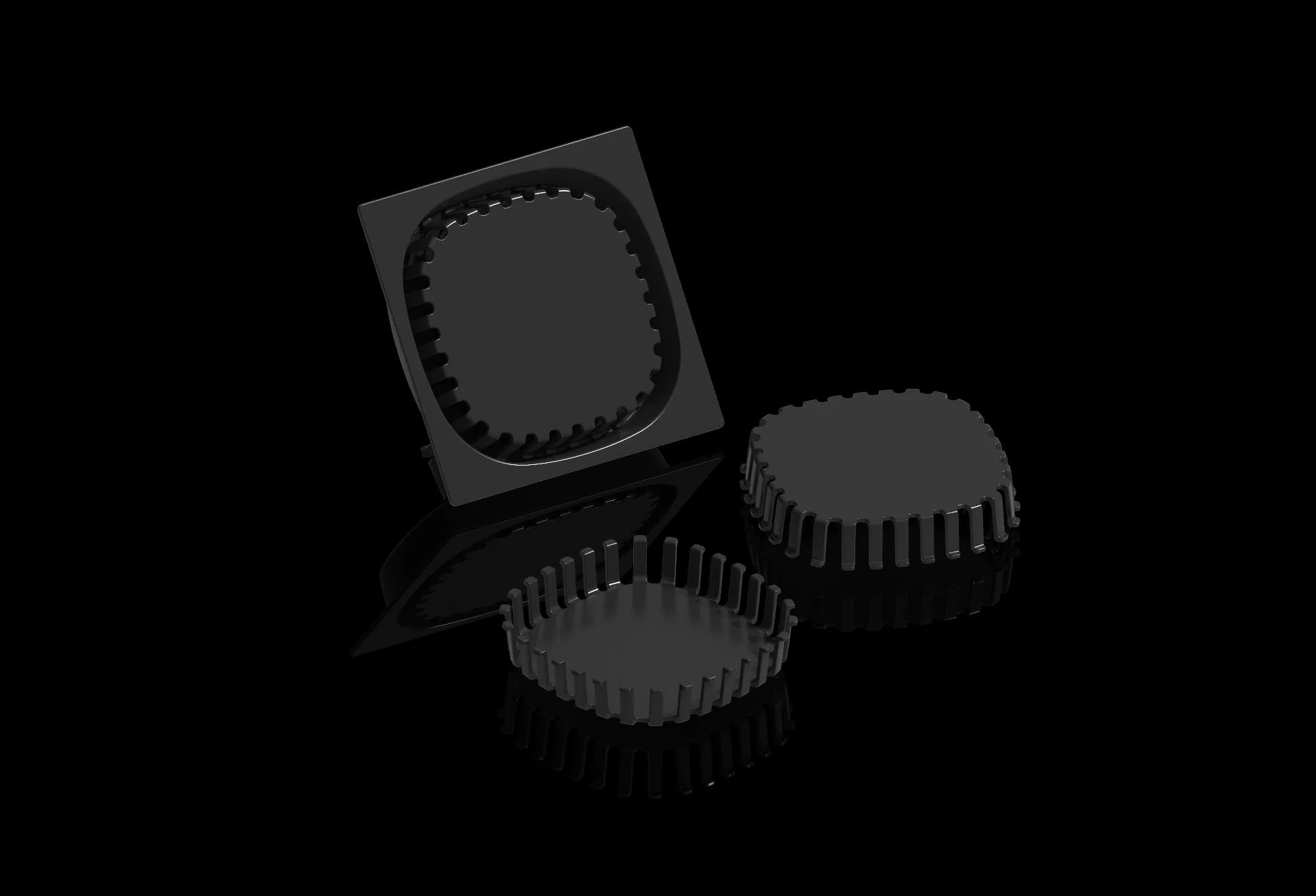
CN110629859B is Wugong's granted invention patent for an easy-clean floor drain: a cover that lifts out together with the hair it has collected, water grooves shaped like an open comb that filter debris without trapping it, and a connecting shaft that lets a stream of tap water spin the whole cover clean. Filed 2019-09-22 by Xiamen Wugong Technology and granted 2021-01-15, it is one of the earlier patents in the portfolio and the one behind the F10010 product line. We covered what makes a floor drain easy to clean in the design article; this piece goes one level deeper, into the patent itself.
The patent is titled "一种易清洁的地漏" ("floor drain easy to clean"), and the full text is public on Google Patents. Everything below is drawn from that published document; nothing is inferred beyond it.
The problem: hair has nowhere good to go
In a conventional drain, hair catches where it can: wrapped around the grate bars, stuffed into the slots, packed against the first narrow transition below. None of those places is designed to hold it, and none is easy to reach. Cleaning becomes an act of retrieval, picking strands out of openings that were shaped to pass water, not to release debris.
The grate makes this worse in a specific way. Closed slots act as a filter with no discharge path: water goes through, hair stays jammed inside the slot itself. The user cannot push it out from below without disassembling the drain, and pulling it out from above tears it into the chamber.
The patent's answer is not a finer filter or a bigger chamber. It changes where the hair is allowed to accumulate, so that removal becomes one motion instead of a retrieval session.
The cover is the collector
The drain body is arranged in steps around the through hole: an upper plane, a support table, and a side wall. The cover sits on the support table and carries three connected surfaces, a top face, a side face, and a skirt that extends outward and rests against the step.
Between the side wall, the skirt, and the side face, the patent defines a hair collecting area. Incoming hair is intercepted by the grooves and comes to rest supported on the skirt edge, in a single defined region, instead of being distributed wherever the flow happens to leave it.
This is what makes the lift-out step work. Because the hair is held on the cover itself, lifting the cover removes all of it at once. The collecting surface and the removable part are the same part.
Open grooves, not closed slots
Around the periphery of the cover, the water passages run continuously through the top face, the side face, and the skirt, and the grooves are open-ended. A dependent claim specifies the arrangement as spiral, so that water is given a direction rather than a barrier.
The open-ended shape is the point. A closed slot traps whatever it catches; a comb-style open groove lets water pass while the hair stays on the outside of the structure, where a rinse can carry it away. Filtering and releasing happen on the same surface, in opposite directions.
Rinse it with the tap itself
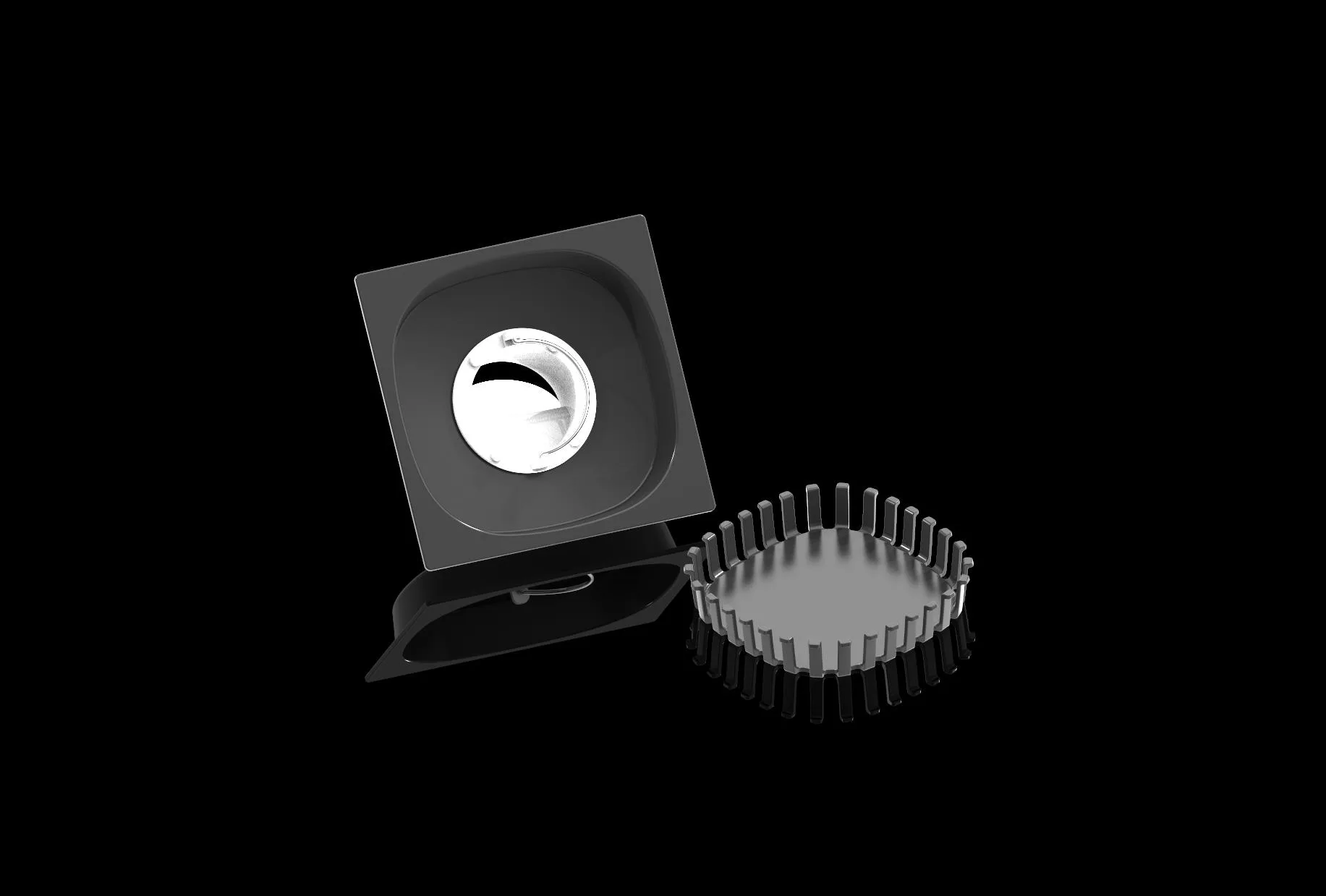
The cover mounts on a connecting shaft with two working parts: a grip with elastic arms, and a rotating shaft that seats in a shaft hole at the cover's axis. For cleaning, the user pinches the grip, takes the cover out, and holds it under a stream of water. The shaft lets the cover spin, and the stream does the work: the same grooves that filtered the hair now channel the rinse flow across it.
For hair that clings, the patent specifies a detachable brush: stainless-steel wire bristles on a handle that interference-fits into the elastic clamping arms. The brush scrubs the grooves while the cover turns, and when it is not needed it stows on the shaft, hidden inside the assembly.
None of this requires tools, and none of it requires the user to reach into the drain body. The cleaning task has been moved entirely to a part that was designed to be held under a tap.
What changes in practice
| Conventional grate drain | CN110629859B | |
|---|---|---|
| Where hair ends up | Jammed in closed slots, packed into the chamber below | On the skirt of the cover, in one defined collecting area |
| Removal action | Pick strands out of slots; reach into the chamber | Lift the cover; the hair comes with it |
| Rinsing | Manual, against slot geometry | Pinch the shaft, hold under tap flow; the cover spins |
| Stubborn debris | Picking and soaking | Detachable wire brush, stowed on the shaft |
| Tools required | Often; and reassembly risk | Hands only |
| Reinstallation | Parts that can sit wrong | Cover returns to its support table in one orientation |
The patent protects structure, and the structure is what removes the cleaning chore: one defined place for debris, one motion to remove it, one flow path to rinse it.
From patent to product: F10010
F10010 is Wugong's floor-drain line built on this patent family, engineered for manufacture with our partner factories in Xiamen. As with every program, certification requirements are designed in from the start and the certificate holder is declared per model and market, by the manufacturing partner or the brand, not implied to sit with the engineering firm.
For a brand evaluating a floor-drain program, cleanability is a service-life argument, not a convenience feature: a drain that is genuinely easy to clean is a drain that keeps its flow and its odor barrier in real bathrooms. The questions to ask any supplier are the ones from the design article: where does hair collect, what does removal take, and can the parts go back together wrong.
Patent facts
| Field | Value |
|---|---|
| Patent number | CN110629859B |
| Title | 一种易清洁的地漏 (Floor drain easy to clean) |
| Applicant | Xiamen Wugong Technology Co., Ltd. |
| Inventors | Jin Zhongcheng (金忠成), Li Gangfeng (李钢锋) |
| Filed | 2019-09-22 |
| Application published | 2019-12-31 (CN110629859A) |
| Granted | 2021-01-15 (CN110629859B) |
| Status | Active; anticipated expiry 2039-09-22 |
| Classifications | E03F 5/04 (indoor floor drains) · B08B 1/00 (rotary cleaning) |
| Verify | Google Patents → CN110629859B |
Frequently asked questions
Does "self-cleaning" mean the drain needs no maintenance?
No. The name describes the disclosed rinse mechanism: the cover spins under tap flow so the grooves clean themselves during a normal rinse. Hair still has to be lifted out first, and heavily used installations still need a routine interval. The mechanism removes the retrieval chore, not the cleaning task.
Does this patent cover the odor barrier?
No. This patent is the cleanability layer: collection, lift-out, and rinse. The water trap or mechanical seal that blocks sewer odor is a separate functional layer, discussed in the design article. A complete drain needs both, and they are evaluated separately.
The patent is granted. Does that prove the drain performs?
A granted patent means the application survived examination of what is claimed: the structure. It is not a flow-rate certificate or an anti-odor test report. Performance claims still need test evidence under stated conditions, which is why we separate the two in every article.
Will it fit any floor build-up?
Fit is a dimension question, not a mechanism question. Grate size, body depth, outlet diameter and direction, and floor build-up must be checked against the installation drawing for the specific model and revision, as with any floor drain.
Work with us
Wugong designs and engineers patent-protected sanitary products in Xiamen, from real problems to manufacturable, certifiable results, coordinating partner factories so a brand gets a differentiated line without building a factory. If you are evaluating a floor-drain program, start a project with us.
Engineering review: Li Renzhong, General Manager at Xiamen Wugong Technology. Invented by Jin Zhongcheng and Li Gangfeng. This article explains a published patent document; it is not legal advice, and the patent claims define the legal scope of protection.