Flushing System Explained
How Smart Toilet Flushing Systems Work: Direct, Stored-Water, and Pump-Assisted Designs
Understand direct-feed, stored-water, and pump-assisted smart toilet flushing, including pressure, flow, water-path, noise, and control tradeoffs.
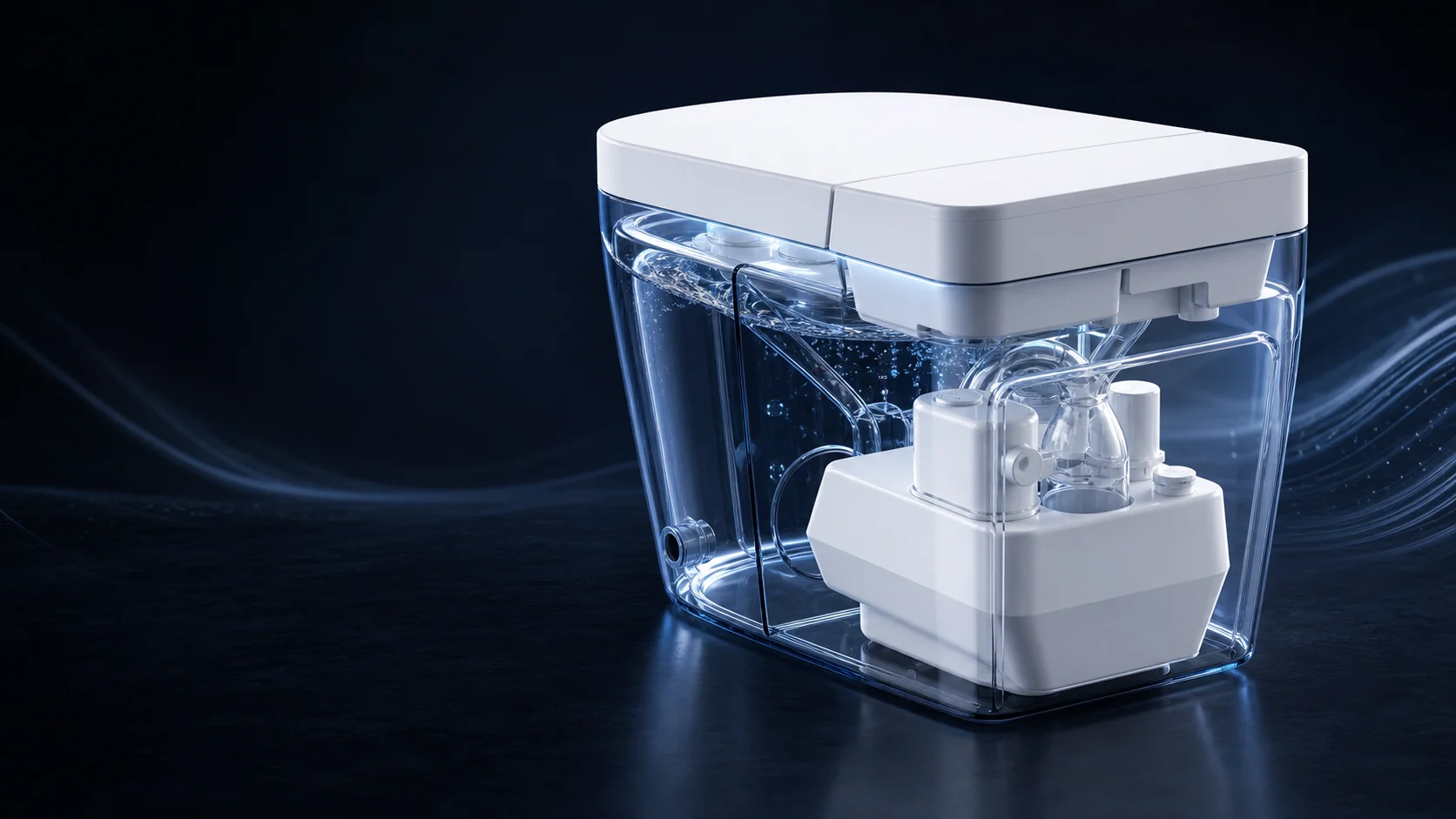
What is a smart toilet flushing system?
A smart toilet flushing system is the complete path that stores or receives water, releases it into the bowl, moves waste through the trapway, and returns the product to a ready state. Depending on the design, that path may include an inlet valve, storage chamber, pump, distribution valves, rim or jet channels, sensors, and an electronic controller.
The system should not be judged by one component or a phrase such as “powerful flush.” Flush performance emerges from the available hydraulic energy and every loss between the inlet and the bowl: pipe restrictions, valve openings, pump behavior, waterway geometry, ceramic shape, outlet timing, and the building supply.
Where does the flush energy come from?
Every design needs enough water, delivered with the right flow pattern, to clean the bowl and move waste through the trap. The main difference between architectures is where that usable energy is available when the flush begins.
- A direct-feed system relies mainly on pressure and flow from the building supply.
- A stored-water system fills an internal chamber between flushes and releases that volume on demand.
- A pump-assisted system uses a pump to control the discharge from stored water or support a designed flow path.
These categories can overlap. A product may use supply pressure to fill a chamber, a pump for one part of the flush, and a separate valve for another. The correct description comes from the actual water path, not the marketing name.
Direct-feed flushing
A direct-feed design can reduce the need for internal storage and may fit a compact body. Its limitation is dependence on the installation. Static pressure with all taps closed does not describe what happens when the flush valve opens. Dynamic pressure, usable flow, pipe size, filters, elbows, flexible hoses, and simultaneous use can all change the result.
This architecture is therefore most predictable where the minimum pressure and flow are known and maintained. If a product datasheet gives a minimum inlet requirement, the installation should be checked under flowing conditions rather than by a no-flow gauge reading alone.
Stored-water flushing
A stored-water system separates the moment of refill from the moment of flushing. It can fill more slowly, hold a defined charge, and release that water over a shorter period. This reduces dependence on a brief pressure drop elsewhere in the building.
Storage does not remove all supply requirements. The chamber still has to refill, its usable volume has to be known, and water level or fill completion needs reliable control. Refill time, internal space, stagnation management, sealing, overflow behavior, and service access become part of the design.
Pump-assisted flushing
A pump can add repeatability by moving stored water through a known path. It does not guarantee a better flush by itself. Pump curves, inlet conditions, voltage, waterway resistance, air in the line, ceramic geometry, and control timing determine what reaches the bowl.
Adding a pump also introduces sound, vibration, electrical demand, moving parts, and possible blockage or wear modes. A useful engineering comparison therefore records the complete cycle: fill state, valve timing, pump command, pressure or flow where measured, bowl behavior, refill, and abnormal-state handling.
Why the ceramic and waterway matter
The bowl is an active hydraulic component. Rim holes, jet direction, channel cross-section, surface shape, and trapway geometry determine whether incoming water forms the intended cleaning pattern and carries waste away. A hydraulic module that performs well with one ceramic body may not produce the same result with another.
This is why a flushing system should be validated with the production-intent ceramic, hoses, valves, and software—not only on an open bench. Any change in a channel, seal, jet, pump, or timing table can alter the final result.

How electronic control coordinates a flush
The controller may check occupancy, water level, supply state, or fault flags before starting. It then opens valves, runs a pump where fitted, sequences rim and jet flow, and stops each actuator at the designed time. Afterward it may refill the chamber and confirm that the system is ready.
Firmware defines this sequence, but a defined sequence is not proof that every unit meets a performance target. Verification needs recorded tests on representative hardware and ceramic under stated pressure, voltage, water temperature, and loading conditions.
How to test a flushing system correctly
A useful test plan separates inputs, process measurements, and outcomes:
- Record static and dynamic inlet conditions, pipe setup, voltage, water temperature, and product configuration.
- Confirm the starting water level or stored volume.
- Capture valve and pump timing, current or speed where relevant, and refill behavior.
- Evaluate bowl coverage, waste transport, residual water level, leakage, abnormal noise, and recovery.
- Repeat across low, nominal, and high supply conditions and after realistic consecutive cycles.
A design threshold is an acceptance target, not a measured result. A product specification is not an independent test. Published numbers should identify whether they are specified, targeted, or observed, together with the test conditions.
Common misunderstandings
- “Zero-pressure” does not mean no water is needed. It normally describes using an already stored charge; refilling still needs incoming water.
- Higher peak flow is not automatically better. Direction, duration, bowl geometry, and waste transport matter.
- A pump does not eliminate hydraulic design. It works within a system curve and a real waterway.
- One successful flush is not validation. Repeatability and worst-case installation conditions matter.
Frequently asked questions
Can a smart toilet flush once when the water supply is off?
Some stored-water designs can use the charge already inside the product. The number of available flushes and the backup control depend on the model.
Does low water pressure always require a built-in tank?
Not always. The answer depends on usable flow, bowl design, valves, and the required performance. Storage and pump assistance are common ways to reduce pressure sensitivity.
Are pump-assisted toilets noisier?
They add a sound source, but perceived noise also depends on pump mounting, enclosure, water path, ceramic, refill, and the room. Compare measured sound under the same conditions rather than architecture labels alone.
Why can the same flushing module behave differently in another bowl?
Because the ceramic channels, jets, surface, and trapway change the hydraulic resistance and flow pattern. Module and ceramic must be validated together.